
Chinese AI startup tops global embodied intelligence benchmark
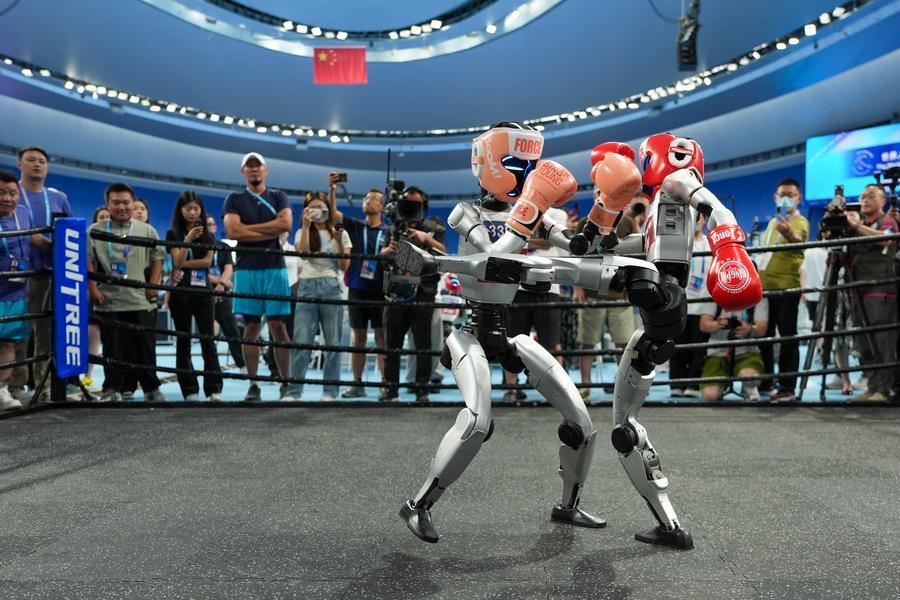
This file photo taken on 临汾新闻网 刘文华Aug. 15, 2025 shows humanoid robots combating during a kickboxing match at the 2025 World Humanoid Robot Games in Beijing, capital of China. (Xinhua/Ju Huanzong)
HANGZHOU, Jan. 13 (Xinhua) -- Chinese startup Spirit AI has said that its Spirit v1.5 embodied intelligence foundation model now ranks first according to the RoboChallenge real-world robotics benchmark, surpassing a leading U.S. model.
According to the RoboChallenge leaderboard, Spirit v1.5 has achieved a total score of 66.09 with a task success rate of 50.33 percent, outperforming the pi0.5 model developed by U.S.-based Physical Intelligence.
Spirit AI said it has open-sourced the leading model and related resources.
RoboChallenge, which industry observers often describe as a "global exam" for robots, is a real-machine evaluation platform that tests embodied intelligence models in physical environments. Its benchmarking process includes 30 tasks covering everyday operations such as object placement, target recognition and tool use.
In addition to achieving the highest overall score on the platform, Spirit v1.5 was also the only model to achieve a success rate above 50 percent, according to publicly available results.
The enterprise was founded in Hangzhou, the capital city of east China's Zhejiang Province, which is also home to AI startup DeepSeek and humanoid robotics firm Unitree Robotics. It focuses on embodied intelligence and robotics research. In June 2025, the company unveiled its Moz1 humanoid robot, targeting enterprise applications such as logistics and industrial scenarios.
Qiu Jiefan, an associate professor at Zhejiang University of Technology, said the top ranking suggests Spirit v1.5 has demonstrated strong overall capabilities across general robotics tasks and real-world execution.
"For embodied intelligence, the ability to understand and perform across multiple tasks and scenarios is very important," Qiu said, noting that while the technology is not yet ready for large-scale deployment, this latest result marks a significant step toward practical application.
Han Fengtao, founder and CEO of Spirit AI, said that Spirit v1.5 has a unified Vision-Language-Action (VLA) architecture that integrates perception, reasoning and action into an end-to-end system, reducing errors associated with established modular approaches. He said the company expects a wider range of service robots to emerge within the next two to three years.
相关阅读
- 家庭医生让群众有“医”靠!广东推动公卫服务进万家
- 长图|一朵花如何让春日经济“一路生花”
- 沙特与巴林间的法赫德国王大桥恢复车辆通行
- 买不起特斯拉人形机器人?那就先买个摆件吧
- 铜陵市少儿图书馆开展“名仕风骨文韵铜乡”活动
- 荧屏宫斗没完没了 细数其中明争暗斗基本套路
- 打出单杆破百 白雨露收获斯诺克世锦赛首胜
- 最近这一条机器“狗”秀翻了!不仅上山入水,还能跳街舞!
- 中新人物丨“网红”导游迪丽努尔:想做一个小小而结实的桥梁
- 最近这一条机器“狗”秀翻了!不仅上山入水,还能跳街舞!
- 国家继续出手调控油价(今天24时起实施)
- 高晓松出狱将全面开工 出版狱中诗集《纪传体》
- 传统文化“点亮”创意开学礼
- 救人不留名!上海金山这位大哥找到了
- 金城武漂亮侄女出道:曾见过叔叔女朋友
- 《铁甲钢拳》 墙铁壁包裹的血肉之心
- 中新人物丨对话维妮娜:在乘风之前,她已经跑了很久
- 沙洋县沈集镇中心卫生院成功抢救心跳骤停患者
- 望江 筹备“文化年货”
- 窃贼发视频叫嚣“来抓我” 民警:安排